Dreaming of Moom Jars and Longing for Spelling Mistakes.
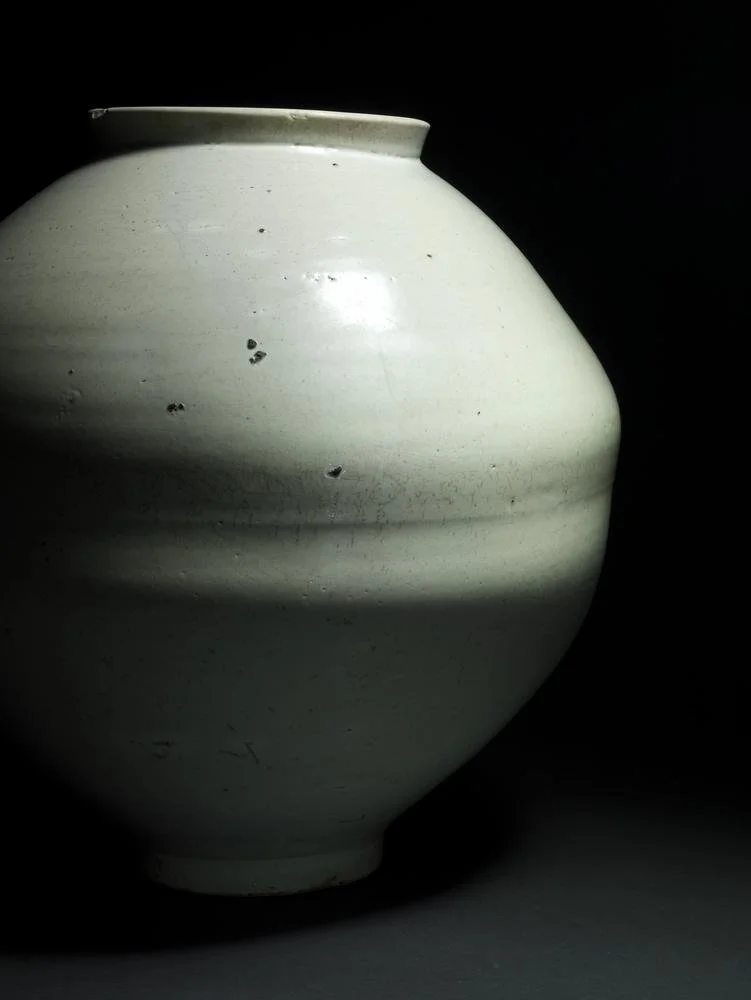
Glazed white porcelain 'full moon' jar, British Museum.
I have a confession to make. About a year and a half ago, I asked Midjourney to generate an image that I could use to promote a community art project. I had very little free time to work on visuals, and I thought I knew exactly what I wanted it to look like, so I typed in a prompt, generated the image, and made some light edits. If you look through my Instagram, you can almost certainly spot it within 30 seconds.
It was full of errors - extra limbs, eyes in unusual places, bits that cut off strangely, and other bits which had seemingly grown from nowhere. I recognise it was plagiarised from datasets of other people’s work; I spent a lot of time fixing it in Photoshop, and in many ways, it did not really look like my work at all. I cut it entirely from the final project, which you can see here.
Now, I have a second confession. I gave a lecture just over a year ago, which I carefully crafted, scripted, and recorded for the incoming class of 2025. I had been searching my references for the perfect quote to begin the talk with, and in my frustration/excitement, I asked ChatGPT to help me find one. Knowing my topic, GPT found me a line from renowned art historian Robert Hughes, which fit so perfectly that it could have been generated specifically for my talk. Turns out it was:
“Every age has its own collective fears and dreams, and these are what give its art its character.“
The quote was a hallucination, and I forgot to check it until after the lecture was already filmed. I did catch it in time, but this meant I had to spend a lot more time refilming and editing. You can see it here. These are instances where I had foregone my own thoughts and skills to do something fast and safe - which turned out to be neither fast nor safe.
And I see this a lot in my work as a teacher, tutor, and critic. Students often forgo their own labour, skills and unique thoughts in order to do something faster and seemingly safer. But they are risking something more integral than being caught for plagiarism or inaccuracy - they are dispensing with their embodied and existential selves. All this to say - I have been thinking a lot about moon jars recently - especially where AI is concerned.
Let me explain.
A South Korean friend once told me that moon jars became particularly symbolic following the Industrial Revolution because of their skilful, asymmetrical, and intentionally wobbly handmade quality. Due to their size, moon jars are traditionally thrown in two halves and joined, which explains the indentation around the spherical centre. However, beyond this, I was told that the master ceramicist often slaps or paddles each jar on the side while it is still malleable, creating an asymmetry, and sometimes a visible dent.
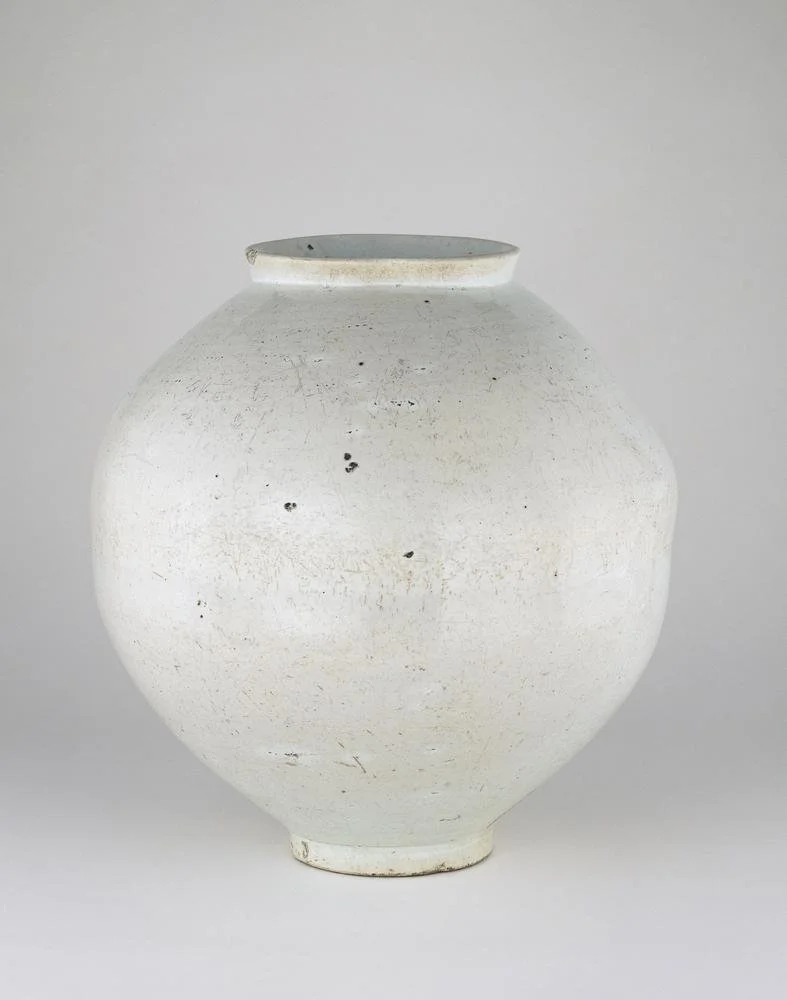
Glazed white porcelain 'full moon' jar, British Museum.
In this way, the jar is believed to embody a more natural aesthetic. The perceived imperfection betrays a vulnerable aura. Walter Benjamin might explain this as a kind of hidden ritualised making, which imbues the jar with a sacred metaphysicality - the slap, recording a unique presence in time and space. This gains new meaning precisely where mechanical and technical reproduction threatens to smooth its origin away, and automate signs of human thought.
While moon jars significantly predate the industrialisation of Korea, they took on a profound additional meaning in the face of sweeping mechanised, factory-driven, globalised forces during the 19th and 20th centuries. In some circles, they were apparently read as a rebellion against the lifeless mould-cast teacups, plates and other ceramics coming from Staffordshire, in the UK, for example. The dent did not make it into a factory reject, but a visible moment of human interaction - captured. I think about these dents and dimples when I am tempted to “quickly” generate an image for something or collate references on a topic. And, I especially think of moon jars in my roles as a teaching fellow, guest critic, and researcher.
It sounds like a strange statement, but I find myself longing for dents, dimples or cracks in the hundreds of essays I grade each semester. I long for something odd, a strange word placement, or an unusual idea, which goes against the grain. Even spelling mistakes show signs of life - I get a little shot of serotonin because I can see there is a human at the other end of this writing. This is not to say that all the essays I see are generated by Large Language Models - far from it; I have had the privilege of teaching such amazing students! But the ubiquity of AI leaves a lingering doubt - and many of the essays do take on a kind of flawless and smooth quality.
In this existential limbo, induced by Large Language Models, it is almost impossible to trust that the writing in front of you is untouched by some biased tech algorithm. Professors, lecturers and teaching fellows have been panicking about this issue - some returning to hand-written, timed and invigilated essays in exam halls. Others began setting note-taking as an assignment in itself, to check the students are actually watching lectures. An innovative approach from the incredible Professor Antoine Picon instructed students to consciously generate their class essays with Large Language Models - then, write a second essay themselves, analysing and criticising the accuracy, creativity and biases of the first. At the beginning of the semester, he stated, “I know I am looking at a class of cyborgs, and this is the reality we must embrace“ - I somewhat paraphrased here. The class, about the history of technology and urban infrastructure, is wildly oversubscribed each year. This critical engagement generated a realisation which Paulo Freire might term a “critical consciousness” of AI slop. Having graded many of these essays myself, one consistent trend appears - the LLMs often generate slop which is deeply biased and bereft of intrigue. In other words - boring, boring, boring. And in their boringness, all kinds of errors, hallucinations and biases get smoothed over.
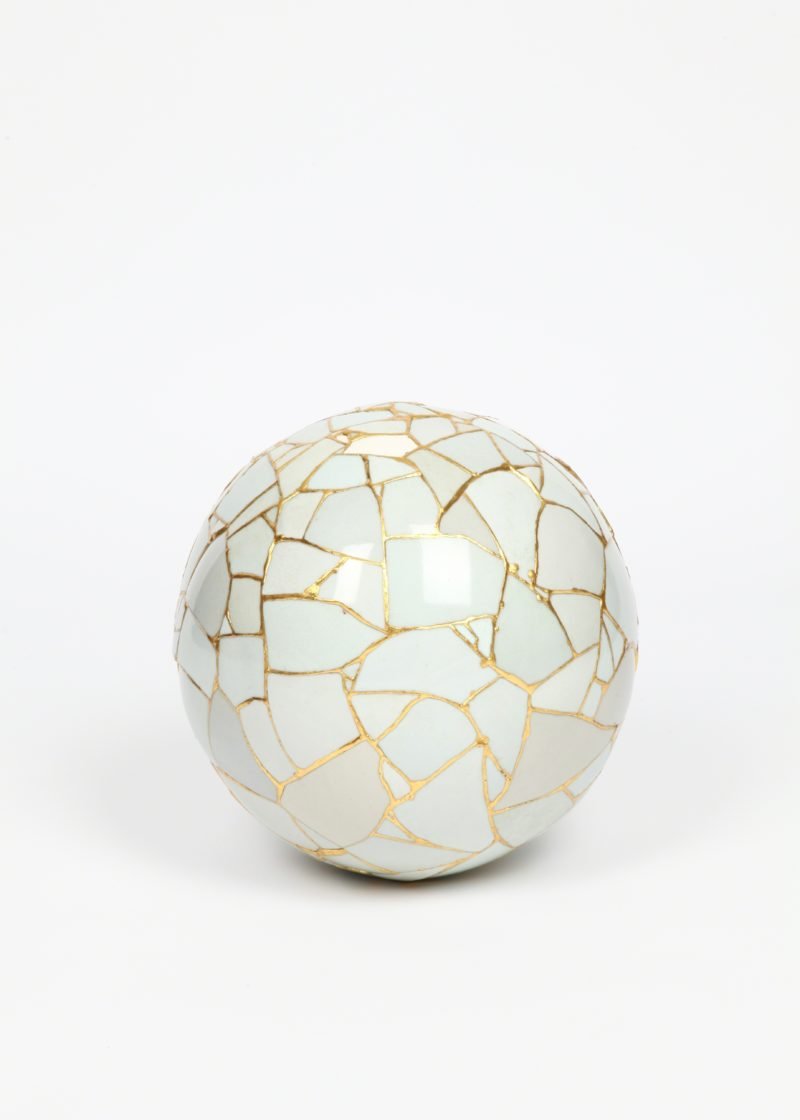
Yeesookyung, “Translated Vase”, 2011, Ceramic shards, epoxy, 24k gold leaf, 33 × 32 × 32 cm.
Across the board, the AI polish makes students feel safe. But surely education is about identifying cracks, questioning things, and developing uniqueness. “But what if I make a mistake?“, they might ask. Well, my old neighbour and friend, a prolific Korean Artist named Yeesookyung, used to talk about this. She often used moon jars in her sculptures, and explored ideas of breaking, mending and becoming magnificent in the process. She often works with shattered ceramic shards - piecing the broken bits together and forming colossal “monsters“, as she would call them.
She once explained to me that the pristine ceramic was uncomfortable for her - unbroken pottery is tense, and tight, and in danger of breaking. She felt more comfortable around the ceramics which had been broken and mended, because they were no longer a source of anxiety, but a beacon of character, and overcoming. Surely that’s what students should be looking to foster in themselves, at universities?
A few years ago, when I was lecturing for UCA and Xiamen University, or even longer ago, when I was teaching in Korea, a spelling or grammar mistake would have felt disappointing - the students had access to spell-check, and it counted as a sign of respect that you read your drafts and caught mistakes. But now, to me, they have become a sign of humanity. In an utterly existential twist of fate, the LLM cultural revolution of this decade has rendered all written work generated-till-proven-typed. Flawless portfolios seem AI-prompted until proven constructed. High-polish is met with suspicion, where rough and spontaneous sometimes seems more honest. This moment seems to have flattened so much of our intellectual and skill-based life into predictable, flawless nothingness and something as simple as a typo brings moments of endearment.
To be clear, I do not blame anyone who finds themselves swept up in this conundrum, as my opening examples demonstrate - I am a culprit too! Even as I type this on Google Docs, I have constant pop-ups asking me if I would like Gemini to refine, rewrite or generate my thoughts for me. Predict my next words - as though it could know me better than I know myself, from a pool of existing data sets. As I look out my office window, Claude has targeted the Harvard campus with A0 posters at every bus stop. Everyone has too much to do, and too little time to do it in, and the dents and dimples are the things which we sacrifice - the character. The ubiquity of ChatGPT, Claude, Grok and other platforms has almost certainly hit the undergraduate and master’s-level students of today hardest - who have also had to cope with the challenges of a COVID-struck educational system in some of their most pivotal years.
But it’s not just the writing. Too many portfolios which are submitted to admissions committees are riddled with images which may, or may not be AI-generated - and appear to have been left deliberately ambiguous in that regard. Over the past years I have sat on Harvard GSD admissions committees, and during one meeting in particular, I remember us pouring over an image of an artwork - trying to work out if it was a real installation, or a generated scene. If it were a photograph, then it would have represented months of labour, manufacturing, collaboration, fundraising, skill in several materials and processes, and deep-level decision-making. It would have been one of the most impressive portfolios of the year. However, if it were an AI-generated scene, then it would have been a quick prompt and maybe some Photoshop adjustments - under an hour of work. That year was the first that we interviewed all candidates.
And this brings me to the question of skill, the importance of failure, and the ability to tweak details yourself.
Interestingly, the paddling of the moon jar is not just an aesthetic move, but also serves in structural strengthening - a sign of a deep understanding of the material. Technically, jars of that scale are incredibly difficult to throw and fire without collapsing - the walls are thin relative to their huge internal areas, and a perfect sphere is apparently likely to slump or warp. The pre-firing slap can pre-stress the structure, giving the ceramicist more control over where that weight might distribute aesthetically. In other words, the potter is deciding where the risks might be, mitigating them, and making decisions around the result. Many essays I have read in the past few years need a good slap. Many art and design projects I have critiqued in the past few years need a good slap, too. I will not say that the students need a slap, but perhaps in a metaphorical sense, this is how we all grow?
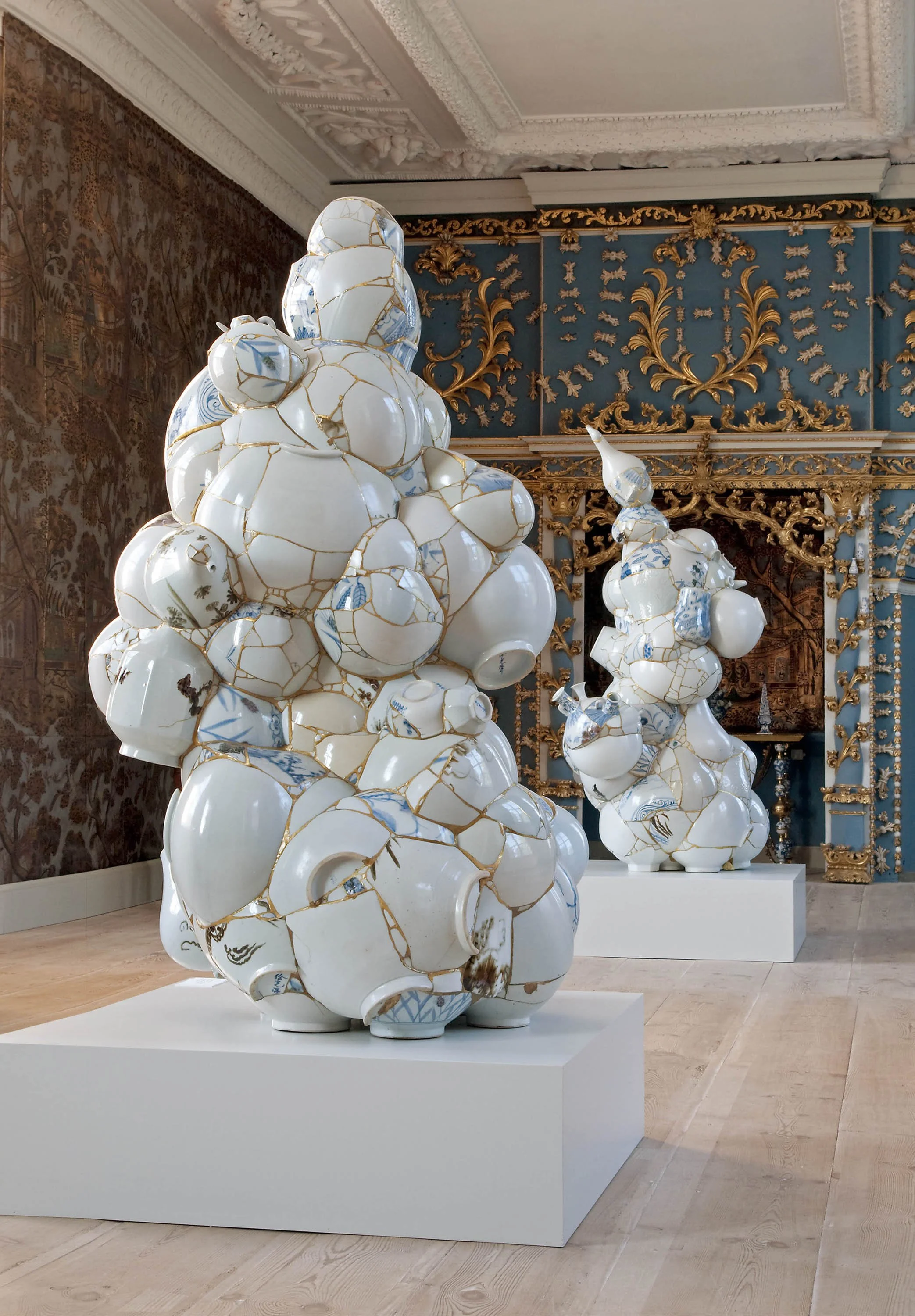
Yeesookyung, “Installation View of Translated Vase”, 2009, ceramic shards, aluminium bar, epoxy, 24K gold leaf, 85 x 170 x 80cm.
How can you know where risks are being taken if a large language model has assembled and screened your essay? Which are the strong conceptual foundations, and which are the thinner and more risky claims? How can you know where new ground is being trodden in the selection of sources, the selection of authors, the clash or complement of arguments and ideologies - simply put, if ChatGPT has supervised and collated the writing of your essay - you may have outsourced everything which makes your work unique and interesting.
So many times, I have happened upon an obscure book in a library, and made it the cornerstone of my research - a source which GPT may never suggest. And beyond making incredibly homogenous and chlorinated grading experiences, the excessive use of GPT can have dire consequences for grades. Over the past few years, I have witnessed students receiving failing grades because of their AI-use - essays which make false claims - essays which reference authors and books which literally do not exist - essays literally on the wrong topics. Hallucinations, which have formed the backbone of arguments. As mentioned above, it’s easily done - I’ve done it!
All of these arguments apply just as aptly to AI-generated video and image content. Much of this technology is a black box, in which one has little agency to make small alterations or improvements. This can make for incredibly boring critiques and passionless defences:
Perhaps the critique committee would ask: “Why did you use these forms, colours, symbols, etc, over on this side?”, and the only response would likely be, “Because Midjourney placed them there.” They may ask if a colour or expression, or some other animated detail might be altered, to which the answer might realistically be, “no - because I have no idea how this would be illustrated, animated, constructed, etc.”
And so, in my reflections about GPT essays and final projects, I find myself thinking about moon jars. And when I come across a spelling mistake, I feel a little groove, dimple, or dent, which reminds me that a human was on the other end of it.
So, as a celebration of plagiarised AI slop, please enjoy this self-plagiarised GPT interpretation of my work. The first follows the prompt, “I want you to generate an artwork image based on my style, and on the ideas which I address in the attached blog post“. The second follows the prompt: “Generate the next artwork you think I might make, based on my style and ideas“. The second is annoyingly cool, though.
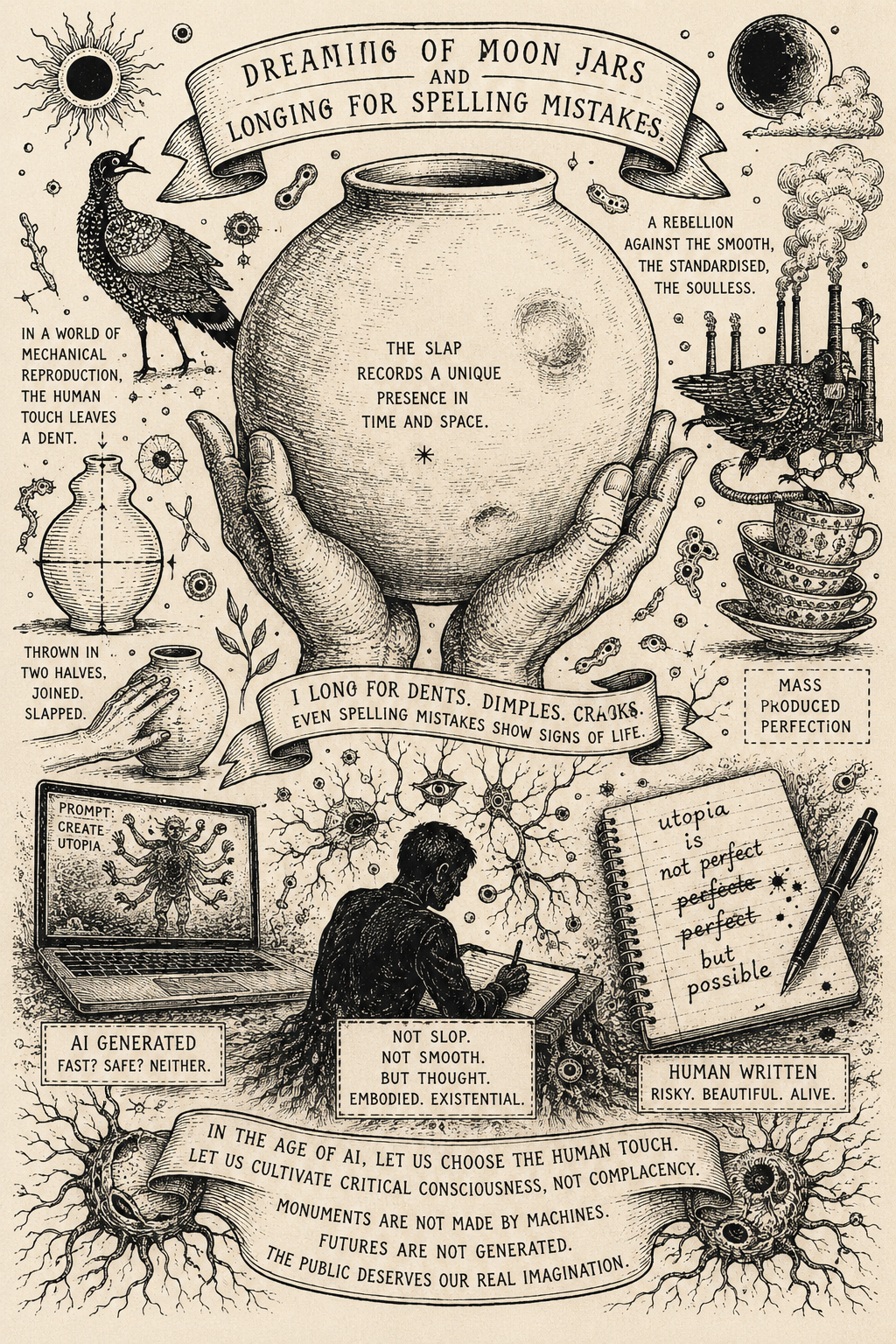
ChatGPT: Bizzare poster AI slop for this blog post.
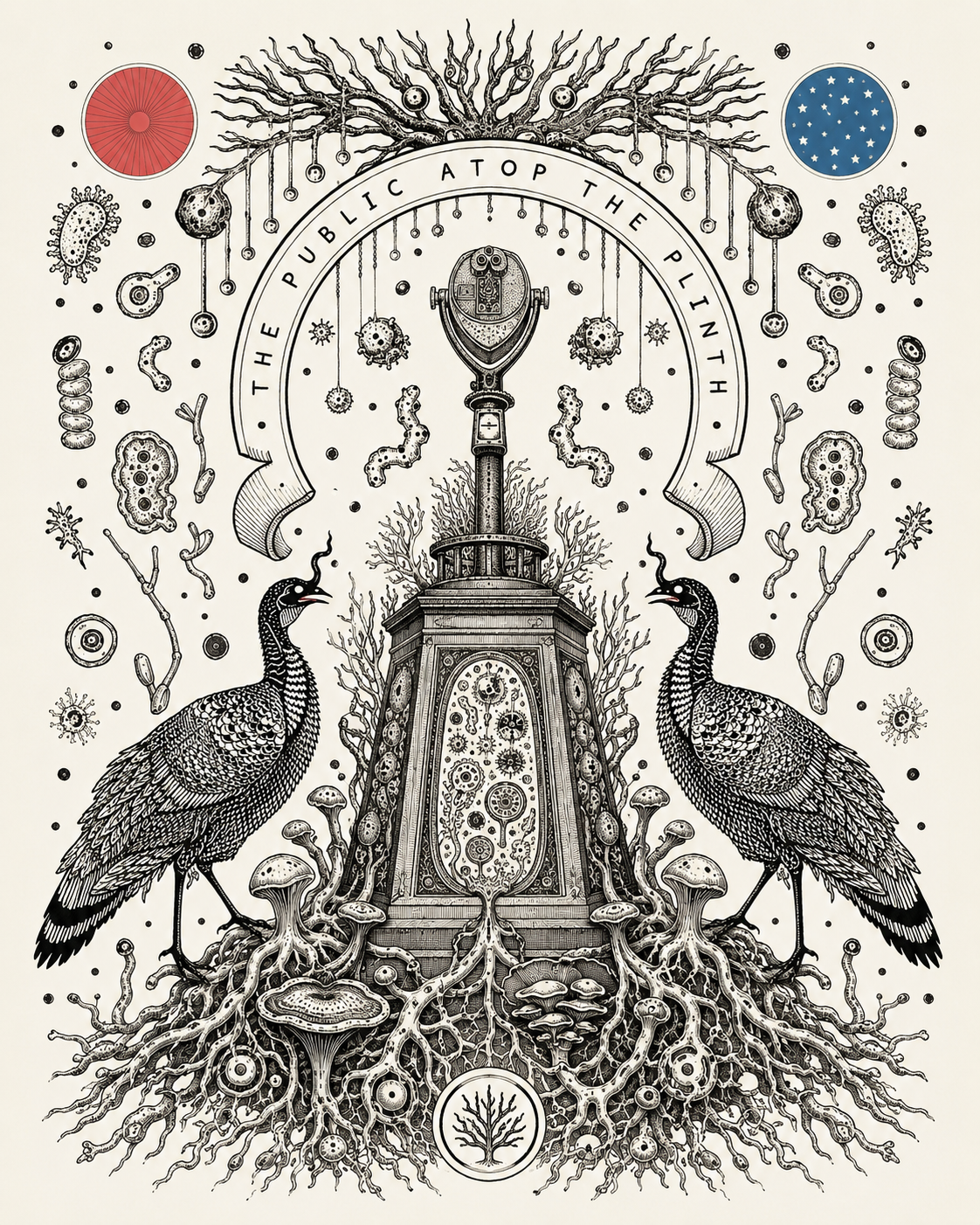
ChatGPT: Annoyingly cool AI slop interpretation of my work.